Easy Virtue (1928)
 | |
| Alfred Hitchcock | |
| Michael Balcon C.M. Woolf | |
| Eliot Stannard | |
| Noël Coward (stage play) | |
| Isabel Jeans Franklin Dyall Robin Irvine Ian Hunter | |
| Claude L. McDonnell | |
| Ivor Montagu | |
| 82 minutes (BBFC) | |
| 70 minutes (2012 restoration) | |
| black & white | |
| silent with English intertitles | |
| 1.33:1 | |
| Gainsborough Pictures | |
| W. & F. Film Service (UK) | |
| DVD (bootlegs only) | |
Synopsis
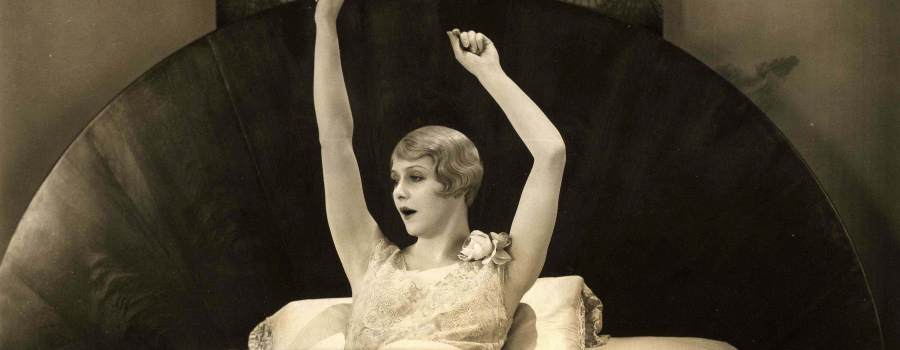
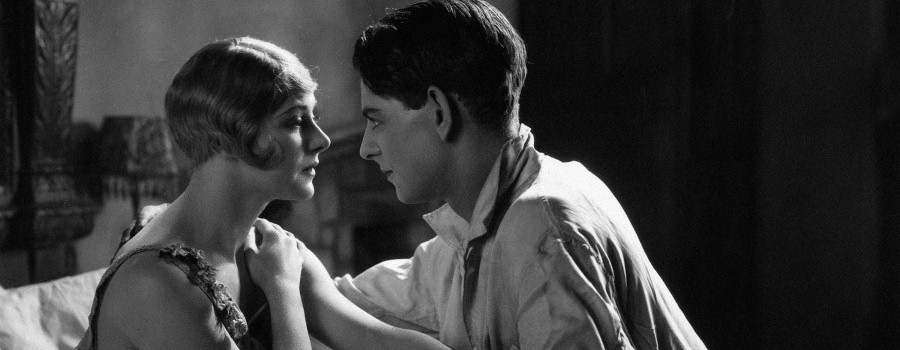
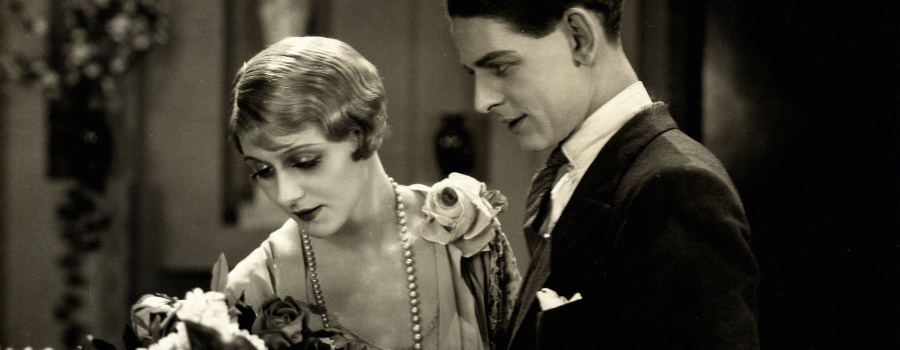
Larita Filton is named as correspondent in a scandalous divorce case. She escapes to France to rebuild her life where she meets John Whittaker. They are later married, but John's well-to-do family finds out Larita's secret. (© IMDB)
Production
Noël Coward's play was first staged in London on July 9th, 1926 and ran at the Duke of York's theatre for 132 performances. Initially, the trade press reported that Graham Cutts would be filming the adaptation.[1]
Pre-Production
Screenplay
Eliot Stannard began work on the scenario for Easy Virtue immediately after he completed his work on Downhill, with editorial input from Angus MacPhail and Ivor Montagu.[2][3]
Casting
Perhaps due to the speed at which the film went into production, many of the cast of Downhill stayed on to appear in Easy Virtue — Isabel Jeans, Robin Irvine, Ian Hunter and Violet Farebrother.
Principal Photography
Filming began at the Islington Studios on Easy Virtue before the final scenes of Downhill had been shot, as Gainsborough were keen to rush the film into cinemas to capitalise on the popularity of Coward's play.[4]
In late March, cast and crew travelled to film footage in the French Riviera and in Nice. Ivor Novello came along as well, in order to complete his Downhill scenes, which were filmed on the rooftop of a French hotel.[5]
For the initial courtroom scene, Hitchcock pulled off another one of his trademark in-camera special effects when the judge peers through his monocle at the plaintiff's counsel:
I had to make the monocle oversized so it would be in focus at close range. Then I put a mirror in it instead of clear glass, and put the attorney character behind the camera, with a double for him in the long shot. And so, when the monocle came up the camera, you saw the man in close-up, without a cut.[6]
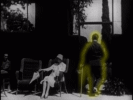
Although it has been widely accepted that Hitchcock made a cameo appearance in the film — walking past a tennis court — the British Film Institute has cast doubt on it, stating "on close inspection it does not appear to be him".[7]
Post-Production
The film was completed in June 1927 and Hitchcock left Gainsborough to start his new three-year contract at British International Pictures (formerly British National).[8]
Release & Reception
Writing in the Manchester Guardian, C.A. Lejeune wrote "for all its cleverness, [it] is not a good film"[9] and The Bioscope review was critical of the source material:
Hitchcock has done the best possible for a subject which does not lend itself readily to the medium of the screen, and he is to be congratulated on having maintained interest throughout with what proves to be very slight material ... In spite of an excellent performance by Isabel Jeans, and Hitchcock's always-apparent resourcefulness and occasional brilliance, this was not one of his more effective films.[10][11]
When Hitchcock discussed the film with François Truffaut, he talked about two scenes in particular. Firstly, he expressed pride in the scene where the audience learns of the outcome of John Whittaker's proposal of marriage to Larita Filton via the facial expressions of a telephone operator (played by Benita Hume). Secondly, he expressed his dislike of the film's final witty intertitle card — "Shoot! There's nothing left to kill." — by calling it "the worst title I've ever written."[12]
Influence
In "English Hitchcock", Charles Barr notes the similarities between Easy Virtue and Downhill — both feature a person taking a "nightmarish journey from England to France and back again" — and also with Hitchcock's 1946 film Notorious:[13]
[Isabel Jeans] is twice referred to, in dialogue titles, as 'the notorious Mrs Filton'; she is oppressed by journalistic cameras, as Bergman is at the opening of "Notorious", and she is hounded in the same way by a mother-in-law who is intent on discovering her disreputable secrets. In the power struggle between the two women, key scenes in both films are played out on the main staircase.
The play was adapted again for the screen in 2008 by director Stephan Elliott and starred Jessica Biel.[14]
Preservation Status
According to the British Film Institute — which recently restored all 9 of the surviving Hitchcock silent films — Easy Virtue only exists as incomplete and degraded 16mm reduction prints:
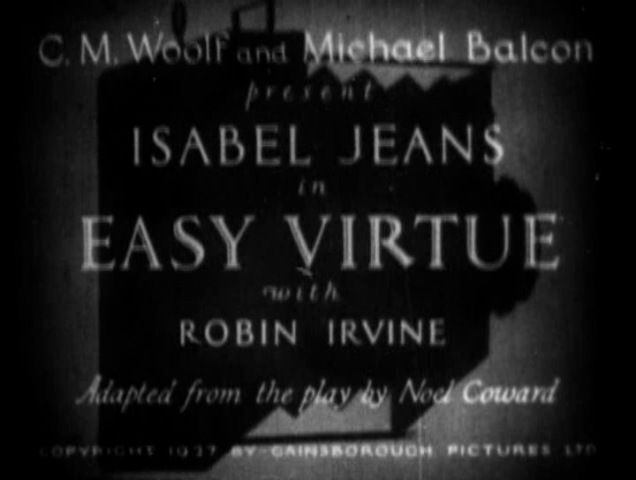
Of all of Hitchcock’s surviving silent films, Easy Virtue has proved the most challenging for the BFI’s restoration team. It survives only in a number of more or less identical 16mm projection prints, all in very poor quality and considerably abridged. The original running time of the film at 7390 feet — amounted to approximately 94 minutes depending on running speed. What survives is equivalent to 5434 feet a mere 69 minutes. We don’t know if a major section is missing or if (more likely) there were dozens, perhaps hundreds, of little trims. We hoped at the beginning of the project that more or better material would turn up, but this has proved elusive. We will of course continue to search. The international search for this Easy Virtue has brought in prints from the U.S., Australia and the Netherlands as well as the UK. Unfortunately, all the existing copies are 16mm prints that have been much projected, resulting in surface wear and tear. All the copies derive from the same source and contain the same printed-in damage. The biggest problem is the underlying picture quality which, thanks to much duplication, is lacking in resolution. Working from such limited material, the best that we can do is to minimize scratches and damage and remake the intertitles. We have chosen the best source and replaced several shots from a second print where they helped to improve quality. All the main titles and intertitles were reconstructed using the original fonts, as in the other Hitchcock restorations.[15]
See Also...
For further relevant information about this film, see also...
- 1000 Frames of Easy Virtue (1928)
- articles about Easy Virtue (1928)
- filming locations
- radio adaptations
- titles and intertitles
- trivia
- web links to information, articles, reviews, etc
Blu-ray Releases
released in 2014

|
Le Passé ne Meurt Pas (1928) - Elephant Films (Blu-ray, France, 2014) ▶ Amazon (France) |
DVD Releases
To date, this film has not been officially released on DVD.
released in 2006

|
Easy Virtue (1928) - Waterfall Home Entertainment Ltd (UK, 2006) NTSC 1.33:1
|

released in 2005

|
Easy Virtue (1928) - Brentwood Home Video (USA, 2005) - part of a box set NTSC 1.33:1
|
Image Gallery
Images from the Hitchcock Gallery (click to view larger versions or search for all relevant images)...
Film Frames

Themes
- the Hitchcock cameo - leaving the tennis court through a side gate

Cast and Crew
Directed by:
- Alfred Hitchcock
- Frank Mills - assistant director
Starring:
- Isabel Jeans - Larita Filton
- Franklin Dyall - Her Husband
- Eric Bransby Williams - The Correspondent
- Ian Hunter - The Plantiff's Counsel
- Robin Irvine - John Whittaker
- Violet Farebrother - His Mother
- Frank Elliott - His Father
- Dacia Deane - Marion Whittaker
- Dorothy Boyd - His Younger Sister
- Enid Stamp-Taylor - Sarah
- Alfred Hitchcock - Man with stick near tennis court (uncredited)
- Benita Hume - Telephone receptionist (uncredited)
Produced by:
Written by:
- Noel Coward - original play
- Eliot Stannard - scenario
Photographed by:
Edited by:
Art Direction by:
Other crew
- Michael Balcon - presenter
- C M Woolf - presenter
Notes & References
- ↑ English Hitchcock (2000) by Charles Barr, 221
- ↑ The Encyclopedia of Alfred Hitchcock (2002) by Thomas M. Leitch, page 89
- ↑ Alfred Hitchcock: A Life in Darkness and Light (2003) by Patrick McGilligan, page 92
- ↑ The Encyclopedia of Alfred Hitchcock (2002) by Thomas M. Leitch, page 89
- ↑ Alfred Hitchcock: A Life in Darkness and Light (2003) by Patrick McGilligan, page 92
- ↑ Alfred Hitchcock: A Life in Darkness and Light (2003) by Patrick McGilligan, page 93
- ↑ BFI Film & TV Database
- ↑ Alfred Hitchcock: A Life in Darkness and Light (2003) by Patrick McGilligan, page 93. McGilligan gives May as the month of completion, but Hitchcock was still filming scenes in early June at the Roehampton Club.
- ↑ The Guardian (03/Sep/1927) - THE WEEK ON SCREEN
- ↑ The Alfred Hitchcock Story (1999) by Ken Mogg, page 17
- ↑ "Hitchcock's British Films" - by Maurice Yacowar, page 37
- ↑ The Encyclopedia of Alfred Hitchcock (2002) by Thomas M. Leitch, pages 90-1
- ↑ English Hitchcock (2000) by Charles Barr, pages 47-9
- ↑ Advocate.com (22/May/2009) - The New Adventures of Old Coward
- ↑ BFI Press Release.
| Hitchcock's Major Films | |
| 1920s | The Pleasure Garden · The Mountain Eagle · The Lodger · Downhill · Easy Virtue · The Ring · The Farmer's Wife · Champagne · The Manxman · Blackmail |
| 1930s | Juno and the Paycock · Murder! · The Skin Game · Rich and Strange · Number Seventeen · Waltzes from Vienna · The Man Who Knew Too Much · The 39 Steps · Secret Agent · Sabotage · Young and Innocent · The Lady Vanishes · Jamaica Inn |
| 1940s | Rebecca · Foreign Correspondent · Mr and Mrs Smith · Suspicion · Saboteur · Shadow of a Doubt · Lifeboat · Spellbound · Notorious · The Paradine Case · Rope · Under Capricorn |
| 1950s | Stage Fright · Strangers on a Train · I Confess · Dial M for Murder · Rear Window · To Catch a Thief · The Trouble with Harry · The Man Who Knew Too Much · The Wrong Man · Vertigo · North by Northwest |
| 1960s | Psycho · The Birds · Marnie · Torn Curtain · Topaz |
| 1970s | Frenzy · Family Plot |
| view full filmography | |
