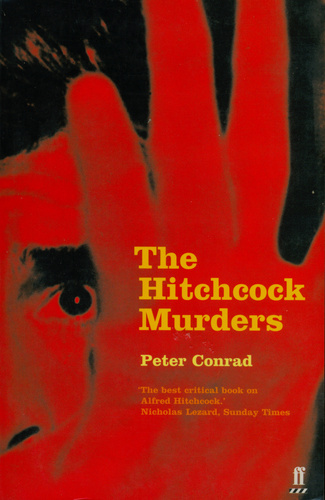
"The Hitchcock Murders" - by Peter Conrad
From Alfred Hitchcock Wiki
Contents |
"The Hitchcock Murders"
- written by Peter Conrad
- published by Faber and Faber (UK, November 2001)
- ISBN: 0571210600
- publisher by Faber and Faber (USA, September 2002)
- ISBN: 0571210600
- Amazon Online Reader: http://www.amazon.com/gp/reader/0571210600/
- LibraryThing: http://www.librarything.com/work/397127
Product Links
paperback:
Amazon Overview
Synopsis
Alfred Hitchcock remains the most famous of film-makers. Why was he so successful in enticing us to share his fears and desires? Cultural critic Peter Conrad can date the start of his Hitchcock obsession to his first boyhood viewing of Hitchcock's Psycho, one afternoon in Tasmania some forty years ago. The master's grip on his imagination has never slackened since. Now Conrad explains how Hitchcock's mastery of the mechanical art enabled him to unnerve and excite us in ways that no artist had previously managed.
Amazon Review
Truffaut once called Hitchcock "the man we love to be hated by", and Peter Conrad knows exactly what he meant. In The Hitchcock Murders, written almost forty years into the author's obsession with the director, Conrad seeks to explain the ways in which Hitchcock terrorises his audiences and -- more importantly -- why viewers allow him to do so. Playing truant from school to watch Psycho on its initial Australian release, the young Conrad was utterly fascinated by the atmosphere of transgression surrounding the film. Starting with the assertion that "for Hitchcock, film was a weapon", Conrad undertakes a breathtaking examination of the director's work.
Leaping from film to film, Conrad eschews chronology in favour of "my own brand of cinematic cross-cutting" -- it is not unusual to find one paragraph considering evidence from films made thirty or forty years apart. Occasionally disorientating, this technique reflects the author's belief that Hitchcock's project remained essentially unchanged throughout his career. Readers with a reasonable knowledge of the director's work will be at a distinct advantage, although Conrad is always careful to explain the context of his examples.
The author's attitude to chronology is accompanied by an extremely eclectic selection of topics in the pursuit of the overall argument. One moment Conrad is considering silence, or the loss of faith in authority figures, and the next he is exploring the significance of handcuffs or lightbulbs in Hitchcock's films, or commenting on the physical appearance of the director himself ("a fat man is above suspicion"). The result is sometimes infuriating, as Conrad refuses to settle down and dwell upon any topic for long, but if anything this simply reveals an embarrassment of riches -- there are simply too many pertinent observations to be neatly constrained within a single volume.
Reviews
- Empire magazine (rated 4 out of 5)
Image Gallery
Images from the Hitchcock Gallery (click to view larger versions or search for all relevant images)...