The Mountain Eagle (1926)
 | |
| Alfred Hitchcock | |
| Michael Balcon | |
| Eliot Stannard Max Ferner | |
| Charles Lapworth | |
| Nita Naldi Bernhard Goetzke Malcolm Keen | |
| Gaetano di Ventimiglia | |
| uncertain | |
| black & white | |
| silent with English intertitles | |
| 1.33:1 | |
| Gainsborough Pictures & Emelka | |
| Wardour Films (UK) | |
| none | |
Synopsis
After spurning his advances, local justice of he peace Pettigrew accuses schoolteacher Beatrice Brent of being a wanton woman and she is forced to flee the village into the mountains. There she meets the hermit John "Fear O'God" Fulton, who she marries. Pettigrew takes advantage of the fact his young son Edward has recently left the village to accuse the hermit of murdering the boy, and Fulton is arrested an imprisoned.
After a year in jail, Fulton escapes and returns to his remote cabin to find Beatrice has given birth to their child. When the baby falls ill, Fulton battles through the snow to seek help in the village, but runs into Pettigrew. The sudden return of Edward forces Pettigrew to drop his accusation of murder against Fulton.
Production
Pre-Production
Charles Lapworth, Gainsborough's editorial director, had developed an original story titled Fear o' God, which was announced in the trade press in October 1925 as the second joint Gainsborough-Emelka production. By the time the film went into production, the title had been changed to The Mountain Eagle.[1]
Screenplay
Eliot Stannard started developing the scenario from Lapworth's story during the autumn of 1925 and it was completed shortly after Hitchcock arrived in Germany to begin filming.[2]
The most in-depth descriptions of the film's synopsis appeared in The Bioscope and the Kinematograph Weekly:
Beatrice Brent, school teacher in a small mountain village, incurs the enmity of Pettigrew, the local Justice of the Peace and owner of the village stores, because he believes that she encourages the attentions of his son Edward, a cripple, who takes evening lessons. Pettigrew, while questioning Beatrice, is himself influenced by her charm and attempts liberties which she strongly resents. He is so furious at the rebuff that he proclaims her as a wanton and she is driven from the village by the inhabitants. Beatrice is saved from their fury by a mysterious stranger known as Fearogod, who lives a solitary life in a cabin to which he takes her for shelter. To stop all scandal, Fearogod takes Beatrice down to the village and compels Pettigrew to marry them, explaining to her that he will help her to get a divorce. Beatrice, however, is content to leave the situation as it is, but Pettigrew, furious with rage, takes advantage of the fact that his son has left the village and arrests Fearogod for his murder. In spite of the fact that there is no vestige of evidence that young Pettigrew has been murdered, Fearogod is kept in prison for over a year, when he decides to escape. He finds that his wife has a baby and he goes off with them to the mountains. When they find that the baby is taken ill, Fearogod goes back to the village for a doctor, where he sees old Pettigrew. Some doubt as to which of the men is going to attack the other first is settled by an onlooker firing off a gun which wounds Pettigrew in the shoulder. The sudden return of his son Edward convinces the old man of the futility of proceeding with his accusation of murder, so he makes the best of matters by shaking hands with the man he has persecuted and all is supposed to end happily.
— The Bioscope (07/Oct/1926)
Pettigrew, J.P. of a small mountain village, hates John Fulton, a lonely dweller in the mountains, known as Fearogod to the inhabitants, as much as he loves his son Edward, who was born a cripple as his mother, whom Fulton has also loved, died. Pettigrew sees his son apparently making love to Beatrice Talbot, the village schoolmistress, and, going to reprove her, he tries to take her in his arms. The son sees this, and leaves the village. Pettigrew determines to have Beatrice thrown out, but Fearogod intervenes, and takes her to his cabin. Pettigrew here sees the chance to arrest Fearogod for abduction and Beatrice as a wanton, but Fearogod forestalls him by coming and demanding that Pettigrew marry them. The pair then fall in love, but Pettigrew has Fearogod arrested and thrown into prison on a charge of murdering his son, who has not returned. Fearogod breaks out of prison after a year, and attempts to fly with his wife and child, but the latter falls sick, and Fearogod returns to the village for a doctor. There he finds Edward has returned, and his affairs cleared up. Pettigrew is accidentally shot.
— Kinematograph Weekly (07/Oct/1926)
More recently, the following preview synopses were found by Dave Pattern for The Hitchcock Zone in British local newspapers:
A picture of great dramatic interest is "The Mountain Eagle," a Gainsborough-Emelka production, with a strong cast, which includes Nita Naldi, Malcolm Keen, Bernard Goetzke, and John Hamilton, not to mention the dog. The interest centres in the lonely and manly figure of John Fulton (played by Malcolm Keen), who is a sort of knight errant of the mountain village, and is nicknamed "Fearogod" from his habit of putting the fear of God into wrong-doers. He has for enemy a general dealer, one Pettigrew, who is the local justice of the peace, a good deal of a hypocrite, and sufficiently learned in the law to "frame" false charges against the hero. The story is too full to tell in any detail, even if it were fair to do so ; picture patrons like to see the evolution of a plot without prior knowledge. Suffice it to say that after "Fearogod's" chivalrous marriage to save the pretty schoolmistress from undeserved slander, the emotional movement of the drama is intensified, till the inevitable happy ending is reached. The Pettigrew of Bernhard Goetzke is a particularly vigorous facial study.
— Gloucestershire Echo (09/Aug/1927)[3]
The principal picture to be seen at the Palladium throughout the present week is "The Mountain Eagle" a story of love and hatred amongst mountain folk. There is a feud over a woman between one Fulton and Pettigrew. The latter as the local justice in a small village naturally has considerable power. His cripple son Edward falls in love with Beatrice Brent, the school teacher appointed by his father and gossip is ripe. The narrative unwinds, as it were, from this incident. Beatrice has to seek refuge with Fulton who arranges a marriage to still the tongues, and Edward having fled, suspicion of having caused his death falls on Fulton. There are some striking snow scenes and fine mountain scenery and many exciting moments, such as where Fulton levels his rifle to shoot Pettigrew and the latter faints and falls before a shot can reach him — instances in which the suspense is very ably contrived. The pursuit of Fulton across the snow plains is done with decision and force.
— Gloucester Citizen (23/Aug/1927)
Casting
The international cast included British actor Malcolm Keen, American "vamp" actress Nita Naldi and German actor Bernhard Goetzke who Hitchcock had befriended during the filming of Die Prinzessin und der Geiger.
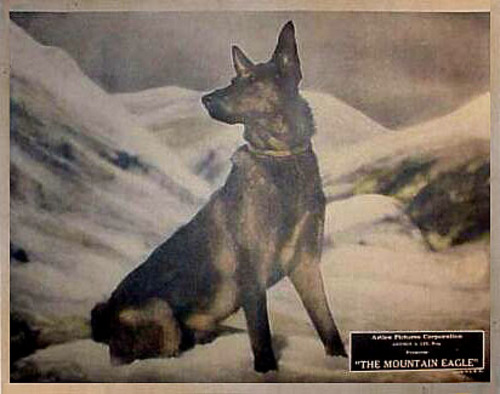
According to several American newspapers, the dog featured in the film — who also appears on the one surviving lobby card — was called "Major".[4]
Principal Photography
Filming seems to have taken place during the months of October and November 1925, initially on location in the Austrian Tyrol mountains and then at the Emelka studios near Munich.
The primary source of information about the film's production comes from an article Hitchcock wrote in 1937 which detailed the problematic location filming in Obergurgl and then Umhausen:
The star I had for the second film I directed was a very considerable star in her day. Her name was Nita Naldi: you probably remember her with Valentino in "Blood and Sand". But she came across the Atlantic to make one picture in Germany for £1,500.
When I read the script I found it was set in the Kentucky hills. My heroine was a pleasant, simple, homely schoolmarm. My star was glamorous, dark, Latin, Junoesque, statuesque, slinky, with slanting eyes, four-inch heels, nails like a mandarin's, and a black dog to match her black, swathed dress.
But the worry was for later. First of all I had to get my mountain scenes. I had no time to go looking for them. I had to ask. I asked everybody in sight: "Where can I get a nice thatched village with snowy mountains in the background and nice tree stuff in the foreground, and no modern stuff that would be out of the picture?"
I was recommended to this place, to that place, to the other place. But this place's only claim to fame was a new glazed-tile town hall; and that place had been recommended because it had just had lamp posts installed; and the other place because the beer was good.
But as I walked along I glanced into a picture shop. I saw a postcard of the perfect location. I went in and asked where it was. "Obergurgel," said they.
[...] We got to Obergurgel. We settled in a cottage. We went out in the evening and plotted out the work for the next day. A few long shots of the snow and the close-ups and medium shots amid the woods. Content as a dog promised a nice bone we went to bed.
When we woke up next day the village was a foot under snow.
That washed us out. The snow meant that we should have to wait six months at least to make the picture at Obergurgel. We took our snow scenes and made our way down the valley, hoping just to beat the falls as they, too, made their way steadily to the lower ground.
We got to a place called Umhaus. It seemed only a fraction less perfect than Obergurgel. We made all our arrangements. We went to bed. And the next morning the village was under snow. There was only one thing to do: produce a thaw.
I got hold of four men who formed the local fire brigade. I convinced them that they must get out the fire engine and wash the snow away. They argued, finally they agreed. They pulled out the great manual pump with its leaky hose and they turned it on the village.
We washed the snow from the houses, from the roofs, from the trees, from the ground ... and on that small area of land, washed clean of snow with a fire engine, our exteriors were made.
I went back to Munich to meet my star. As she stepped off the train Munich quite audibly gasped. They had never seen anything like her before. She travelled with her father, who looked like Earl Haig. Her Louis SIV heels clicked down the platform. The dog on its leash was long and gleaming with brushing. Her maid followed her. It was like the royalty Germany hadn't seen for five years.
But I was thinking of a simple Kentucky Miss in a gingham gown and a cotton apron. I had to produce a strong woman of the mid-western mountains who handled a gun instead of a lipstick.
First we quarrelled about her nails. They came down from half an inch beyond the finger to a quarter. We had another discussion. They came down to an eighth. Another discussion and they were all right. The heels came down layer by layer. The makeup was altered shade by shade. The hair was changed curl by curl.
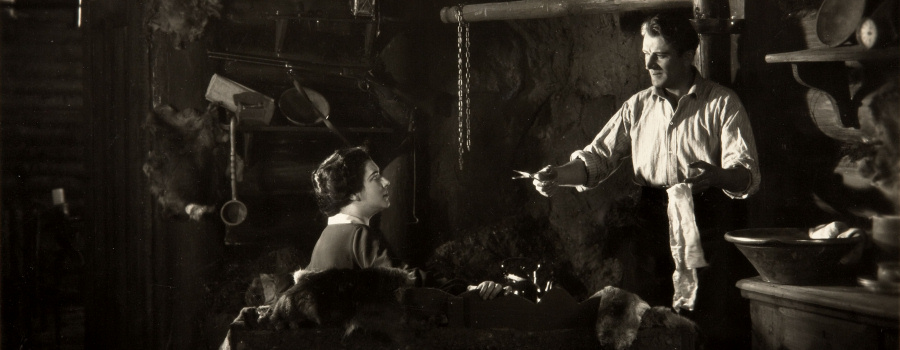
I shall never forget one afternoon. We had been working hard all the day, and Nita was nearly all in. She had to play one more scene, where she was cleaning Malcolm Keen's rifle when a face appeared at the window and she pointed the gun at him.
The scene was going well when, just as she turned the gun to the window, I saw it waver. It veered from side to side. It moved up and down. It went round in circles. Then, without a word, Nita tilted to one side and fell headlong.
The floor was very hard. The set was built on a foundation of stones set in cement. Before the camera had even stopped turning, she had recovered. She got to her feet and wanted to go on playing, but we called it a day.
A few weeks later, when Alma and I were married, we went to Paris for our honeymoon and spent the first day of it with Nita. But that is another story — and one I'm not going to tell.
— Alfred Hitchcock, "Life among the Stars" in the News Chronicle (1937)
Although Hitchcock mentions Kentucky as the setting in the original script, whilst exhaustively researching the film, scholar J.L. Kuhns found no evidence to support the claim that the film itself was supposed to have been set in America.[5] Various contemporary newspaper reviews named the mountains as being in Europe, Kentucky or the American North West, so possibly the film's location was identified on an intertitle card which varied by print.
Post Production
With the production phase finished, Hitchcock returned to London and completed editing the film by the end of 1925.
Release & Reception
According to J.L. Kuhns' authoritative essay on the film, published in the Hitchcock Annual (1998), the film was screened in Berlin in May 1926, then shown to the British press in October 1926 before being scheduled for public release in May 1927. Kuhns notes that it is likely the film was shown at a number of trade shows outside of London during October 1926, but only one print of the film would have been required. At least 4 prints of the film must have been made: two for the English trade shows and subsequent provincial release in the U.K., one for the German market and another for the U.S., where it was listed as being available from November 1926.[6]
Kunhs also notes that the length of the film was recorded as 7,503 feet at the London trade show, but only 5,302 feet in the U.S. Motion Picture News advertisements. Although the reason for this discrepancy is unknown, the implication is that the U.S. print had been edited down into a shorter film.[7] The suggested projection speed of the film is not known, but the London trade show print could have run for anywhere between 83 minutes (24fps) to 125 minutes (16fps).[8]
The film received a seven-month distribution in the U.K. from June 1927 to January 1928, with a least two prints in circulation. Film historian Jenny Hammerton has speculated that the distributor Wardour Films may have abandoned a more widespread release in favour of releasing Downhill, which would help explain the lack of any surviving prints.[9][10]
In October 1926, The Kinematograph summarised the film as "rather wandering and not too convincing story, which is redeemed by good, if somewhat slow, direction and excellent acting", complaining that the "continuity is jerky". However, the reviewer felt the "photography is excellent".[11]
The film was screened on Friday 7th January 1927 at the Passage Bioscoop cinema in Amsterdam, Netherlands, as part of a German film festival.[12] Screenings also took place in Spain — Valencia in June 1928 and Madrid in January 1931.[13]
In February 1927, the Bakersfield Californian previewed the film prior to it being shown in the town:[14]
The latest picture to star Nita Naldi is "The Mountain Eagle." It's one of the best this popular star has ever appeared in. Primitive passion's play a strong part in the lawless country where the mountains rear their majestic peaks and the eternal snows menace the unwary and where the bullet is a law unto itself. Miss Naldi is cast as a primitive mountain lass and her work is all that could be desired. There are more than the usual number of thrills even for a Naldi picture and the picture, in addition, offers some scenic gems.
The British Daily Mail briefly reviewed the film in late May 1927:[15]
It is full of character though undramatic, and reveals the screen-charm and considerable talent for film acting of Mr. Malcolm Keen. Mr. Bernhard Goetzke, well remembered for his appearance as Death in "Destiny," is sincere and powerful as Mr. Keen's protagonist, whilst Miss Nita Naldi gives the only human performance in all her career and does not "vamp" at all.
The Bioscope review was critical of the scenario:[16]
Director Alfred Hitchcock has not been particularly well served by his author, and in spite of skillful, and at times brilliant direction, the story has an air of unreality. Bernard Goetzke gives a fine performance, Malcolm Keen is admirable and Nita Naldi achieves considerable success. Many small character parts are admirably played and skillfully directed. There are some unusual lighting effects and excellent photography by Baron Ventigmilia.
In his essay, German Hitchcock, Joseph Garncarz summarises the film's reception in Germany:
Hitchcock's films were unpopular in with German audiences because they were "too English" in their mentality and casting. Most German film critics, however, highly valued Hitchcock's films, because they judged them as being artistically interesting and stylistically influenced by the German art film tradition. What all German film critics strongly disliked, by contrast, was the use of intertitles, which clearly opposed the aspirations of German art cinema.
Speaking to François Truffaut about the film, Hitchcock simply said that "it was a very bad movie".[17]
U.K. Release
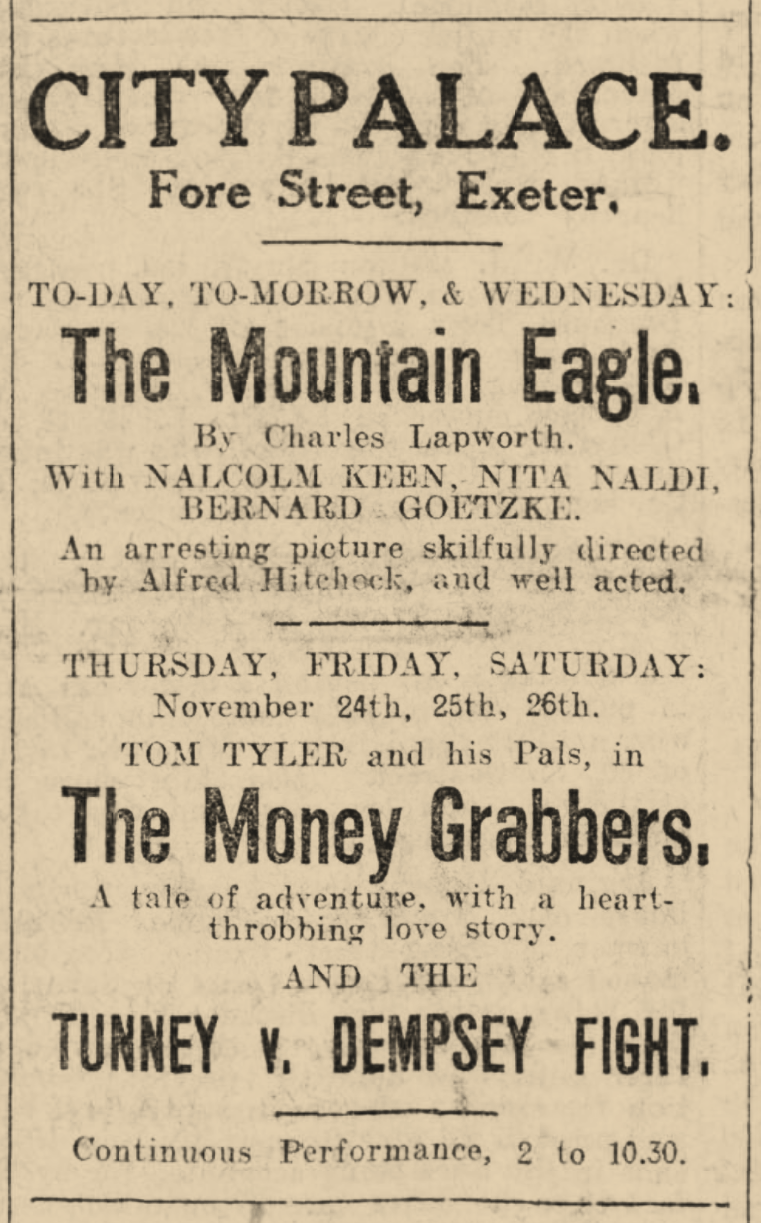
The following screening dates appeared in British local newspapers:
- 06-08/Jun/1927 — Beau Nash Picture House, Westgate Street (Bath, Somerset)[18]
- 06-08/Jun/1927 — Tower Picture House (Leeds, Yorkshire)[19]
- 23-25/Jun/1927 — The Whitehall Theatre (East Grinstead, Surrey)[20]
- 24/Jun/1927 — Theatre De Luxe, Kirkgate (Leeds, Yorkshire)[21]
- 30/Jun/1927-02/Jul/1927 — Kosmos Kinema (Tunbridge Wells, Kent)[22]
- 07-09/Jul/1927 — Victoria Hall, Commercial Road (Portsmouth)[23]
- w/c 11/Jul/1927 — Regent Hall, Mansfield Road (Nottingham)[24]
- 01-03/Aug/1927 — Northern's Cinema (Hartlepool)[25]
- w/c 08/Aug/1927 — The Daffodil (Cheltenam)[26]
- 15-17/Aug/1927 — Exchange Hall Cinema (Grantham, Lincolnshire)[27]
- 22-27/Aug/1927 — The Palladium (Gloucester)[28]
- 05-06/Sep/1927 — The Pavilion (Burnley, Lancashire)[29]
- 12-14/Sep/1927 — Victory Cinema (Sandy, Bedfordshire)[30]
- 29/Aug/1927 — Empire Picture Palace (Tonbridge, Kent)[31]
- 22-24/Sep/1927 — Lichfield Palladium (Lichfield, Staffordshire)[32]
- 29/Sep/1927-01/Oct/1927 — The Oxford Cinema (Oxford)[33]
- 03-05/Oct/1927 — The Palladium (Plymouth)[34]
- 06-08/Oct/1927 — Bath Cinema (Leamington Spa, Warwickshire)[35]
- 06-08/Oct/1927 — Olympia Theatre, 56 Market Place (Arbroath, Scotland)[36]
- 21-23/Nov/1927 — City Palace, Fore Street (Exeter)[37]
- 28-30/Nov/1927 — Belgrave Cinema (Mutley, Plymouth)[38]
- 29-31/Dec/1927 — Oakham Picture Theatre (Oakham, Rutland, East Midlands)[39]
- w/c 31/Jan/1928 — Exchange Picture House (Taunton, Somerset)[40]
U.S. Release
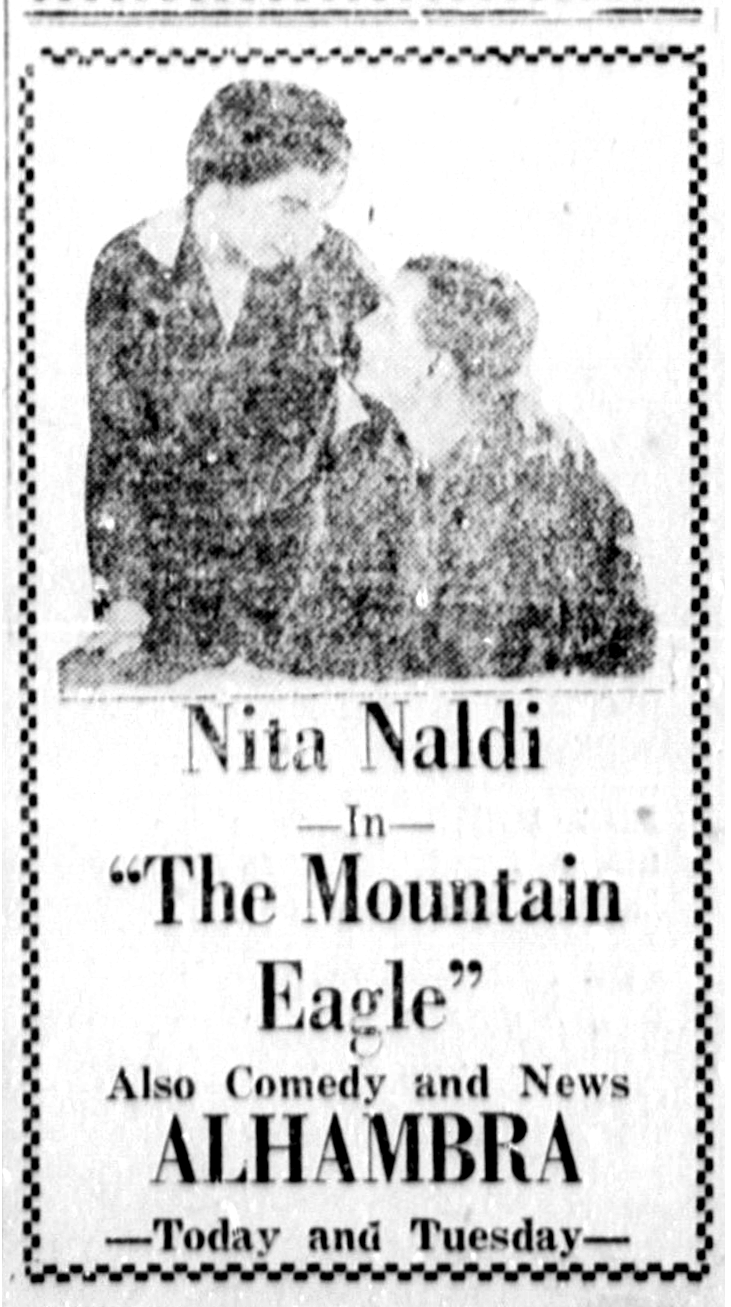
From U.S. local newspapers, some dates that The Mountain Eagle was screened are known:
- 05/Feb/1927 — The Nile (Bakersfield, California)[41]
- 25-26/Feb/1927 — The Capitol (Lowell, Massachusetts)[42]
- 13/Mar/1927 — The Orpheum (Munster, Indiana)[43]
- 13/Oct/1927 — The Orphium (Xenia, Ohio)[44]
- 28/Nov/1927 — Park City (Bridgeport, Connecticut)[45]
- 05-06/Dec/1927 — Alhambra (Breckenridge, Texas)[46]
- 16/Jan/1928 — The Deandi Theater (Amarillo, Texas)[47]
- 02-03/Feb/1928 — The Rex Theater (Ardmore, Oklahoma)[48]
- 06/Jul/1928 — The Anderson (Hattiesburg, Mississippi)[49]
- 09/Dec/1929 — The Kozy Theater (Ludington, Michigan)[50]
One U.S. newspaper advert states that Nita Naldi's character was named "Gladys Martin" in the film, implying that the American print may have had different character names.[51]
Preservation Status
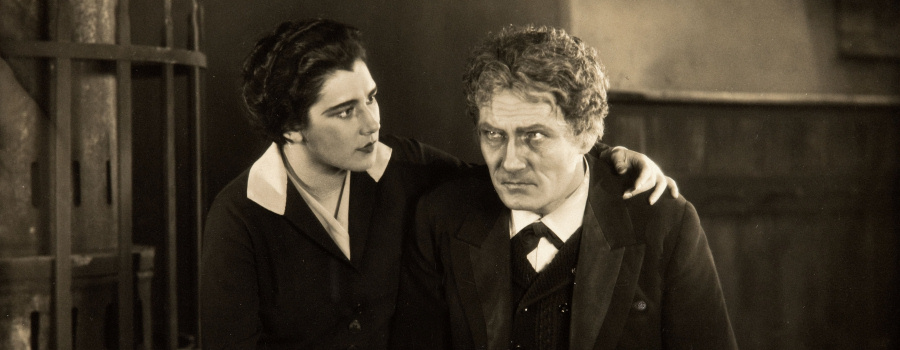
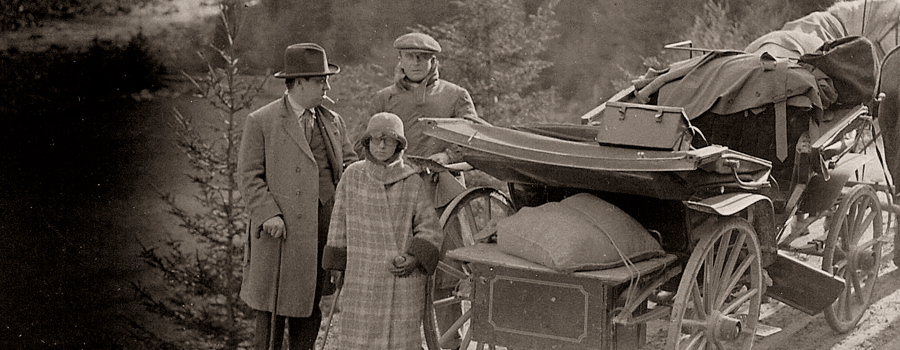
A number of publicity stills survive from the production phase of The Mountain Eagle. During his research on the film, J.L. Kuhns identified 43 separate images in various collections and archives, some of which appear to be enlargements of film frames.[52] Since Kuhns carried out his research, a further photograph has emerged of Hitchcock, Alma Reville and Malcolm Keen, which was almost certainly taken during location filming.[53]
No known prints of the The Mountain Eagle have survived and the film is currently listed on the BFI's Most Wanted list.
See Also...
For further relevant information about this film, see also...
- articles about The Mountain Eagle (1926)
- complete cast and crew
- filming locations
- web links to information, articles, reviews, etc
DVD Releases
none
Image Gallery
Images from the Hitchcock Gallery (click to view larger versions or search for all relevant images)...
Themes
Cast and Crew
Directed by:
- Alfred Hitchcock
- Alma Reville - assistant director
Starring:
- Nita Naldi - Beatrice
- Malcolm Keen - John "Fear o' God" Fulton
- John F Hamilton - Edward Pettigrew
- Bernhard Goetzke - Mr Pettigrew
- Ferdinand Martini
Produced by:
Written by:
- Eliot Stannard
- Max Ferner
- Charles Lapworth - story
Photographed by:
Art Direction by:
Notes & References
- ↑ Hitchcock Annual (1998) - Hitchcock's "The Mountain Eagle". According to Kuhns' research, claims that the film was released in America as Fear o' God are completely unfounded.
- ↑ Alfred Hitchcock: A Life in Darkness and Light (2003) by Patrick McGilligan, 71
- ↑ Curiously, the articles goes on to mention a second film screening at the cinema, The Poacher, which it states is set in the Austrian Tyrol — this appears to have been the German film Der Wilderer (1926).
- ↑ See, for example, Bakersfield Californian (05/Feb/1927) - Nita Naldi Tonight for Last Times
- ↑ Hitchcock Annual (1998) - Hitchcock's "The Mountain Eagle". Kuhns notes that Peter Noble appears to have made the assumption about Kentucky, possibly based on Hitchcock comments about the script, and that Noble's assumption "has dogged this film since its early citations in the literature".
- ↑ See U.S. publications The Film Year Book 1927 and Motion Picture News (Apr/1927). The latter lists the film as 5,302ft and distributed by Artlee (a portmanteau of Arthur Lee who was one half of Lee-Bradford).
- ↑ Distributors frequently edited imported films to make them more viable to their local market.
- ↑ Hitchcock Annual (1998) - Hitchcock's "The Mountain Eagle"
- ↑ BFI most-wanted: The Mountain Eagle
- ↑ Naldi's career was in decline at the time and Wardour Films would perhaps likely feel that an Ivor Novello film would be a more lucrative bet for the British market. The dates of the known U.K. screenings overlap in June and October, so at least two prints must have circulated.
- ↑ Kinematograph Weekly (1926) - The Mountain Eagle
- ↑ See advertisement in Het Vaderland (06/Jan/1927). The Passage Bioscoop was a 450 seat cinema opened in 1919 and eventually closed in 1959, before being destroyed by a fire in 1963.
- ↑ Thanks are due to Robert Boon for locating the details of these European screenings, along with some of the U.S. screening dates.
- ↑ Bakersfield Californian (01/Feb/1927) - Nita Naldi Appears in Mountain Film
- ↑ Daily Mail (23/Mar/1927).
- ↑ The Bioscope (1926) - The Mountain Eagle
- ↑ Hitchcock (1967) by François Truffaut, page 39
- ↑ Reported in the Bath Chronicle and Weekly Gazette (04/Jun/1927).
- ↑ Reported in Yorkshire Evening Post (04/Jun/1927).
- ↑ Reported in the Surrey Mirror and Country Post (17/Jun/1927).
- ↑ Reported in the Yorkshire Evening Post (24/Jun/1927).
- ↑ Reported in the Kent and Sussex Courier (24/Jun/1927).
- ↑ Reported in the Portsmouth Evening News (07/Jul/1927) and Portsmouth Evening News (08/Jul/1927).
- ↑ Reported in the Nottingham Evening Post (11/Jul/1927).
- ↑ Reported in the Hartlepool Mail (30/Jul/1927) and Hartlepool Mail (02/Aug/1927). Northern's became a bingo hall in 1960.
- ↑ Reported in the Gloucestershire Echo (09/Aug/1927). The Daffodil was an Art Deco style cinema opened in 1922. It ceased showing films in the 1960s and was converted into a bingo hall. It is now The Daffodil Restaurant.
- ↑ Reported in the Grantham Journal (13/Aug/1927).
- ↑ Reported in the Gloucester Citizen (23/Aug/1927).
- ↑ Reported in the Burnley News (03/Sep/1927).
- ↑ Reported in the Biggleswade Chronicle (09/Sep/1927).
- ↑ Likely 29-31/Aug/1927. Reported in the Kent and Sussex Courier (26/Aug/1927).
- ↑ Reported in the Lichfield Mercury (16/Sep/1927).
- ↑ Reported in the Whitstable Times and Tankerton Press (24/Sep/1927).
- ↑ Reported in the Western Morning News (01/Oct/1927).
- ↑ Reported in Leamington Spa Courier (30/Sep/1927).
- ↑ Reported in the Arbroath Herald and Advertiser for the Montrose Burghs (30/Sep/1927).
- ↑ Reported in the Devon and Exeter Daily Gazette (21/Nov/1927) & Exeter and Plymouth Gazette (14/Nov/1927).
- ↑ Reported in the Western Morning News (30/Sep/1927).
- ↑ Reported in the Grantham Journal (24/Dec/1927). The Oakham Picture Theatre was known locally as the "Tin Tabernacle" and was apparently constructed from corrugated iron.
- ↑ Reported in the Taunton Courier and Western Advertiser (25/Jan/1928).
- ↑ Reported and previewed in the Bakersfield Morning Echo (05/Feb/1927).
- ↑ Reported in the Lowell Sun (25/Feb/1927).
- ↑ Reported in the Hammond Times (12/Mar/1927).
- ↑ Reported in the Xenia Evening Gazette (13/Oct/1927).
- ↑ Reported in Bridgeport Telegram (28/Nov/1927).
- ↑ Reported in the Breckenridge Daily American on 05/Dec/1927 and 06/Dec/1927
- ↑ Reported in the Amarillo Sunday News Globe (15/Jan/1928).
- ↑ Reported in the Ardmore Daily Ardmoreite (03/Feb/1928). Although the advert could imply the screenings were talking place the following week (9th & 10th), a brief mention on page 5 of the newspaper confirms a screening took place on the 3rd.
- ↑ Reported in the Hattiesburg American (06/Jul/1928).
- ↑ As reported in Ludington Daily News (08/Dec/1929) and Ludington Daily News (09/Dec/1929).
- ↑ See Ludington Daily News (08/Dec/1929).
- ↑ Hitchcock Annual (1998) - Hitchcock's "The Mountain Eagle"
- ↑ http://digitalcollections.ucsc.edu/cdm/singleitem/collection/p265101coll23/id/328/rec/33
| Hitchcock's Major Films | |
| 1920s | The Pleasure Garden · The Mountain Eagle · The Lodger · Downhill · Easy Virtue · The Ring · The Farmer's Wife · Champagne · The Manxman · Blackmail |
| 1930s | Juno and the Paycock · Murder! · The Skin Game · Rich and Strange · Number Seventeen · Waltzes from Vienna · The Man Who Knew Too Much · The 39 Steps · Secret Agent · Sabotage · Young and Innocent · The Lady Vanishes · Jamaica Inn |
| 1940s | Rebecca · Foreign Correspondent · Mr and Mrs Smith · Suspicion · Saboteur · Shadow of a Doubt · Lifeboat · Spellbound · Notorious · The Paradine Case · Rope · Under Capricorn |
| 1950s | Stage Fright · Strangers on a Train · I Confess · Dial M for Murder · Rear Window · To Catch a Thief · The Trouble with Harry · The Man Who Knew Too Much · The Wrong Man · Vertigo · North by Northwest |
| 1960s | Psycho · The Birds · Marnie · Torn Curtain · Topaz |
| 1970s | Frenzy · Family Plot |
| view full filmography | |
